

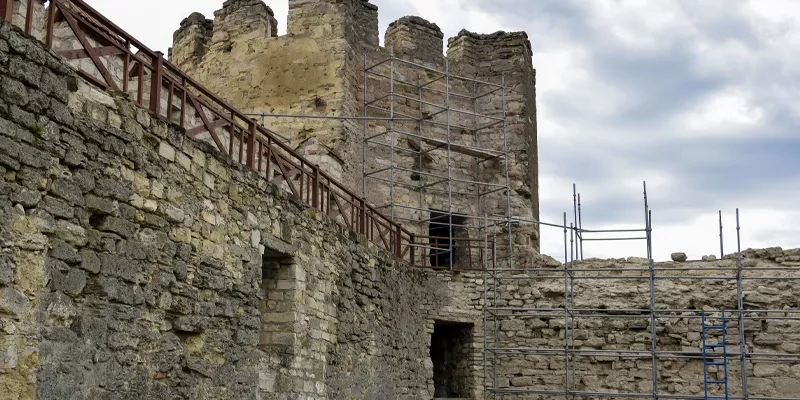
Historical artifacts are our cultural heritage that bear the traces of the past, and over time these structures can be damaged due to natural conditions, earthquakes, human intervention, or material fatigue. Restoration of historical artifacts is critically important both to preserve the aesthetic integrity of these structures and to ensure their structural safety.
The carbon fiber FRP strengthening fabrics and structural reinforcement materials used in this process must both meet modern engineering requirements and be of a nature that will not damage the historical fabric. This is precisely where modern, natural, and durable materials such as basalt fiber, basalt anchors, and basalt mesh come into play.
Lightweight, Durable, and Compatible Basalt Fibers
Basalt fiber is an eco-friendly material obtained from volcanic rocks. Although it is produced in a similar way to glass fiber, it has much higher heat and chemical resistance.
The main reason basalt fiber is preferred in the restoration of historical structures is that its lightweight nature does not impose additional load on the load-bearing system and that it is compatible with historical materials. Basalt Fiber Reinforced Polymers (BFRP) can be used in walls, vaults, or arches. Unlike traditional strengthening methods, they do not damage the structure and can be integrated in a way that is invisible to the eye.
In addition, thanks to its non-magnetic nature, it does not affect the original texture and functional use of historical structures.
Deep Reinforcement Solution: Basalt Anchors
Carbon basalt anchor systems are used especially for internal reinforcement of cracked structures or weakened load-bearing elements. These anchors are injected into load-bearing walls or floors to increase both tensile and compressive strength. Compared to traditional steel anchors, they are resistant to corrosion, which ensures long-lasting applications. Basalt anchors are also preferred in archaeological or delicate architectural structures because they do not generate electromagnetic effects.
These systems both facilitate the integration of new structural elements and allow existing damage to be remedied with minimal intervention.
Surface Reinforcement and Distribution Layer: Basalt Mesh
Basalt mesh reinforcement fabric is used to prevent surface cracks and increase the overall rigidity of the structure. Applied over historical stone or brick surfaces with special bonding mortars, it prevents cracking and homogenizes load distribution.
Its greatest advantage is that it ensures excellent compatibility with the structural material, allowing the walls to breathe. In addition, being thin enough to be almost invisible makes it possible to strengthen the structure without disturbing the appearance of the historical fabric. It provides long-term durability after restoration and minimizes the risk of sudden collapse.
Protecting the Past with Modern Materials
The restoration of historical artifacts is not merely a repair process, but a responsibility to preserve cultural heritage. Therefore, the materials used must provide maximum protection without damaging the historical structure. Basalt fiber, basalt anchors, and basalt mesh are among the most ideal structural reinforcement materials that meet this need.
With their natural composition, high durability, and low intervention requirements, they have become indispensable tools in restoration projects. If you are working on historical building restoration or looking for materials in this field, you should definitely consider basalt-based systems. For structures that respect the past and are strong for the future, choosing the right material is everything.